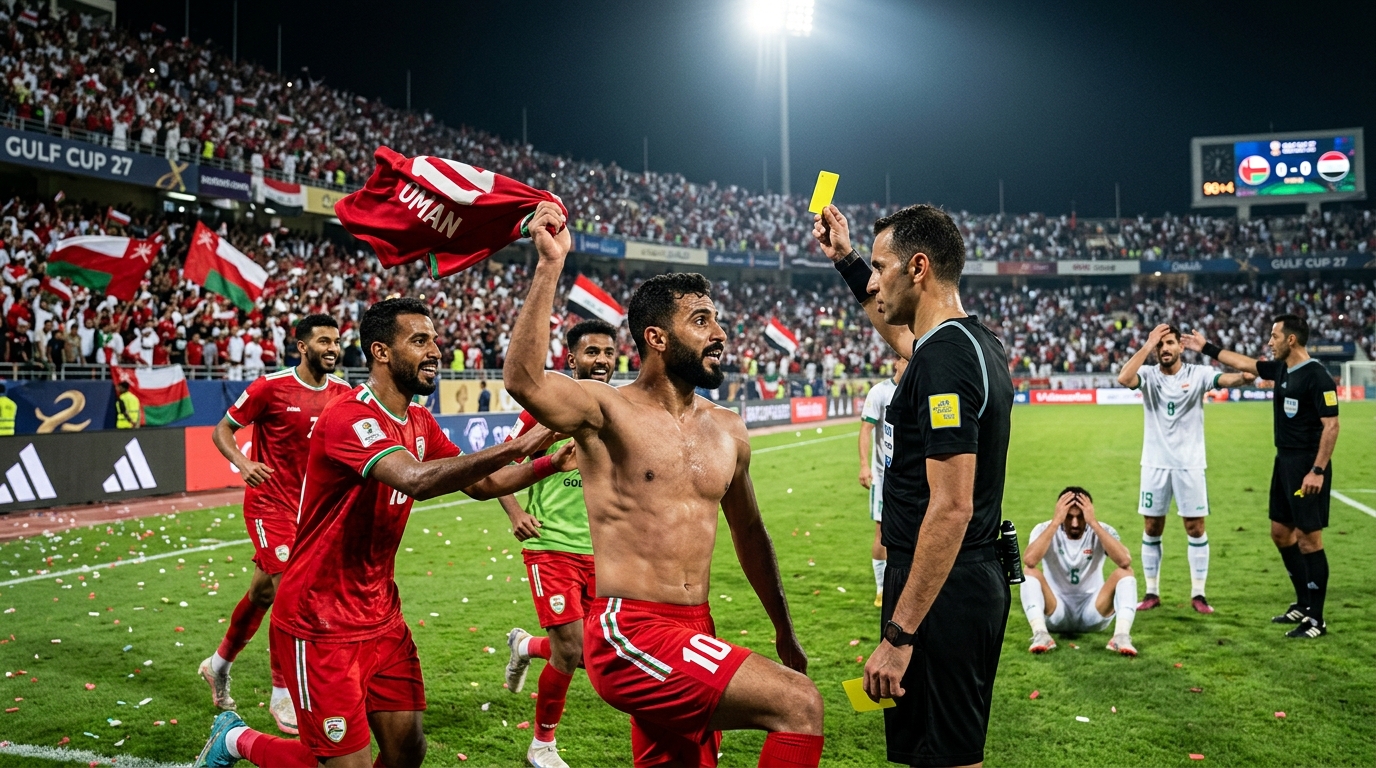
One Shirt Changed Everything: Oman and Iraq Head to a Draw for Gulf Cup 27 Qualification
The final round of Group A at the 27th Arabian Gulf Cup produced one of the most dramatic and unusual endings of the tournament.
Saudi Arabia secured a place in the semi-finals after defeating Iraq 2-0, while Oman came from behind to beat Kuwait 3-1. Those results left Oman and Iraq level on points and, remarkably, level on several other tie-breaking criteria.
Just when Oman appeared to have secured the second semi-final place, a yellow card received during a goal celebration changed the calculations again.
The final decision had to be left to a draw.
Iraq Started the Final Round in a Strong Position
Before the final round, Iraq were second in Group A with four points, while Oman had only one point.
Iraq had drawn 1-1 with Oman in the opening round and then defeated Kuwait 3-2. Oman, meanwhile, had drawn with Iraq before losing 3-0 to Saudi Arabia.
That meant Iraq entered the final round with a significant advantage.
Oman needed to beat Kuwait and hope that Iraq lost to Saudi Arabia, while also making up the goal difference separating the two teams.
Oman Fell Behind Against Kuwait
Oman's task became even more difficult when Kuwait took the lead.
At that point, Oman were facing elimination unless they could completely turn the match around.
But the situation began changing in the second half.
Nasser Al Rawahi scored Oman's equalizer, bringing the score to 1-1 and keeping Oman's qualification hopes alive.
At the same time, the other Group A match between Saudi Arabia and Iraq was developing in a way that dramatically changed the calculations.
Saudi Arabia Defeat Iraq
Saudi Arabia scored twice against Iraq and eventually won 2-0.
The result left Iraq on four points, meaning Oman could draw level with them by winning against Kuwait.
Suddenly, the outcome of the Oman-Kuwait match became decisive.
Every goal mattered.
Oman Complete a Remarkable Comeback
Oman continued pushing forward after the equalizer.
The team eventually took the lead and then scored a third goal to make it 3-1 against Kuwait.
That result gave Oman four points — exactly the same number as Iraq.
At first, it appeared that Oman had done enough to overtake Iraq and claim the second semi-final place.
The celebrations began.
But the story was not over.
The Shirt Celebration That Changed the Calculation
After scoring Oman's third goal, Musab Al Shakshi celebrated by taking off his shirt.
The referee immediately showed him a yellow card, as removing a shirt during a goal celebration is punishable under the Laws of the Game.
Normally, such a booking would be little more than a minor detail in a football match.
This time, however, it became a crucial part of the qualification battle.
Oman and Iraq had already reached the same number of points, and the teams were also level in the relevant goal-based criteria.
The next possible separator was the disciplinary record.
And that was where Al Shakshi's yellow card became extremely important.
Why the Yellow Card Mattered So Much
Reports indicated that Oman initially had an advantage in the fair-play calculation.
Oman had seven yellow cards compared with eight for Iraq.
That would have given Oman the advantage if the disciplinary record had remained unchanged.
But Al Shakshi's booking brought Oman's total to eight yellow cards.
Suddenly, Oman and Iraq were level even in the fair-play criterion.
The goal that appeared to have sent Oman through had therefore created an extraordinary final twist.
The celebration itself did not cancel Oman's qualification. Instead, the yellow card received during that celebration removed the disciplinary advantage that could have separated Oman from Iraq.
From Qualification Celebration to Confusion
Oman players celebrated after the final whistle, believing that their dramatic comeback had been enough.
But the final calculations showed that there was no longer a clear winner between Oman and Iraq under the applicable tie-breaking criteria.
Both teams had four points.
They were level on the relevant goal difference and goals scored, and the earlier meeting between them had also ended 1-1.
The fair-play criterion could no longer separate them either.
The result was an exceptionally rare situation in which the tournament regulations required another method to determine the second qualifier.
Why Was a Draw Needed?
The draw was not being used simply because the teams had the same number of points.
Football competitions normally have several tie-breaking criteria designed to separate teams with identical points.
In this case, however, the available criteria failed to produce a winner between Oman and Iraq.
With both teams reaching the same position in the relevant calculations, the tournament organizers turned to a draw to determine which team would join Saudi Arabia in the semi-finals.
A Night of Constantly Changing Calculations
The drama came from the fact that the two matches were being played simultaneously.
The result in Saudi Arabia affected Oman, while every goal in the Oman-Kuwait match affected the qualification calculations involving Iraq.
At one point, Iraq appeared to be safely through.
Then Saudi Arabia's goals changed the situation.
Oman's comeback against Kuwait then brought the two teams level.
And finally, Al Shakshi's yellow card meant that even the disciplinary record could not separate them.
A match that had looked like a straightforward qualification battle therefore ended with both teams waiting for a draw.
What Happens Next?
Saudi Arabia finished at the top of Group A and secured its place in the semi-finals.
The second semi-final place from Group A remained between Oman and Iraq.
According to reports published after the matches, the organizers scheduled a draw in Jeddah to determine which of the two teams would advance. The draw was scheduled for midnight Saudi time, or 1:00 a.m. UAE time.
The unusual ending has made the final night of Group A one of the most talked-about moments of Gulf Cup 27.
A Yellow Card That Became Part of Tournament History
The story of Oman and Iraq is a reminder of how every detail can matter in tournament football.
Oman had to overcome an early deficit against Kuwait, score three goals, and wait for Iraq to lose to Saudi Arabia.
When all of that happened, Oman appeared to have completed the comeback necessary to reach the semi-finals.
Then one moment of celebration produced a yellow card.
That booking changed the fair-play calculation, left Oman and Iraq completely level, and sent the qualification decision to a draw.
From a goal and a celebration to a yellow card and finally a draw, the final night of Group A produced a qualification battle that was decided by the smallest details.
The Draw Sends Oman Through
One of the most unusual endings in Gulf Cup 27 has finally been settled. A draw of lots was held between Oman and Iraq at the InterContinental Hotel in Jeddah, after the two teams remained level on four points and could not be separated by the applicable tie-breaking criteria. The draw ultimately sent Oman through to the semi-finals, while Iraq were eliminated from the tournament at the group stage.