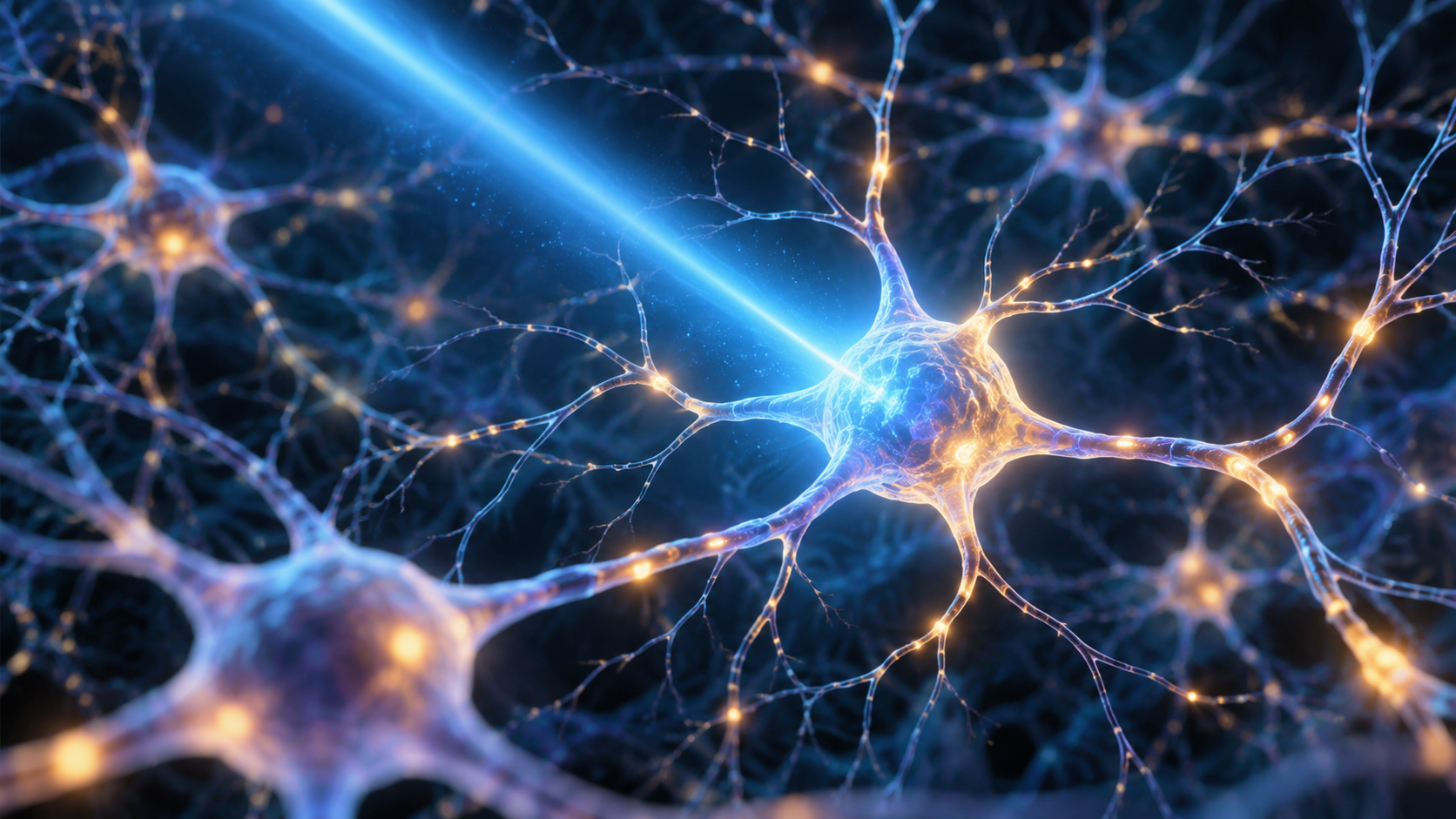
AI-generated conceptual illustration; not a photograph of the event or an exact scientific diagram.
The 2026 Nobel Prize in Physiology or Medicine has gone to Karl Deisseroth, Peter Hegemann and Georg Nagel for work on light-sensitive ion channels and optogenetics. Announced on October 5, the award recognises discoveries that changed how researchers investigate nerve cells.
The central idea sounds surprising: use light to influence the activity of selected cells and examine their role in a living biological system.
Who won the 2026 medicine Nobel?
- Karl Deisseroth works at Stanford University in bioengineering and psychiatry.
- Peter Hegemann is associated with Humboldt University of Berlin.
- Georg Nagel conducted research at the University of Würzburg for more than two decades.
What is optogenetics?
Optogenetics combines genetic methods with light-sensitive proteins. Researchers introduce these proteins into selected cells, then use light to alter their activity. The technique can help activate or inhibit nerve cells, depending on the tools used.
This is more than taking a picture of an active brain. It allows experiments that test what happens when a particular group of cells changes its activity.
How did algae help?
The foundations include proteins found in green algae that respond to light. Research on these proteins led to channelrhodopsins becoming tools for controlling cell activity. Deisseroth helped apply light-sensitive microbial proteins to mammalian nerve cells.
Why is this important for neuroscience?
Researchers can investigate neural circuits with greater precision, including circuits involved in neurological and psychiatric disorders. The European Research Council also notes clinical exploration of the approach, including research aimed at restoring sight.
Does the prize announce a ready-made treatment?
No. Recognition of a research method does not by itself establish that a particular treatment is approved or suitable for patients. The reported award concerns discoveries and research capabilities; possible medical applications need their own evidence.
The practical change is in the questions scientists can ask: instead of only watching cells act together, they can test the contribution of selected cells. That makes the discovery valuable without turning future possibilities into present-day promises.