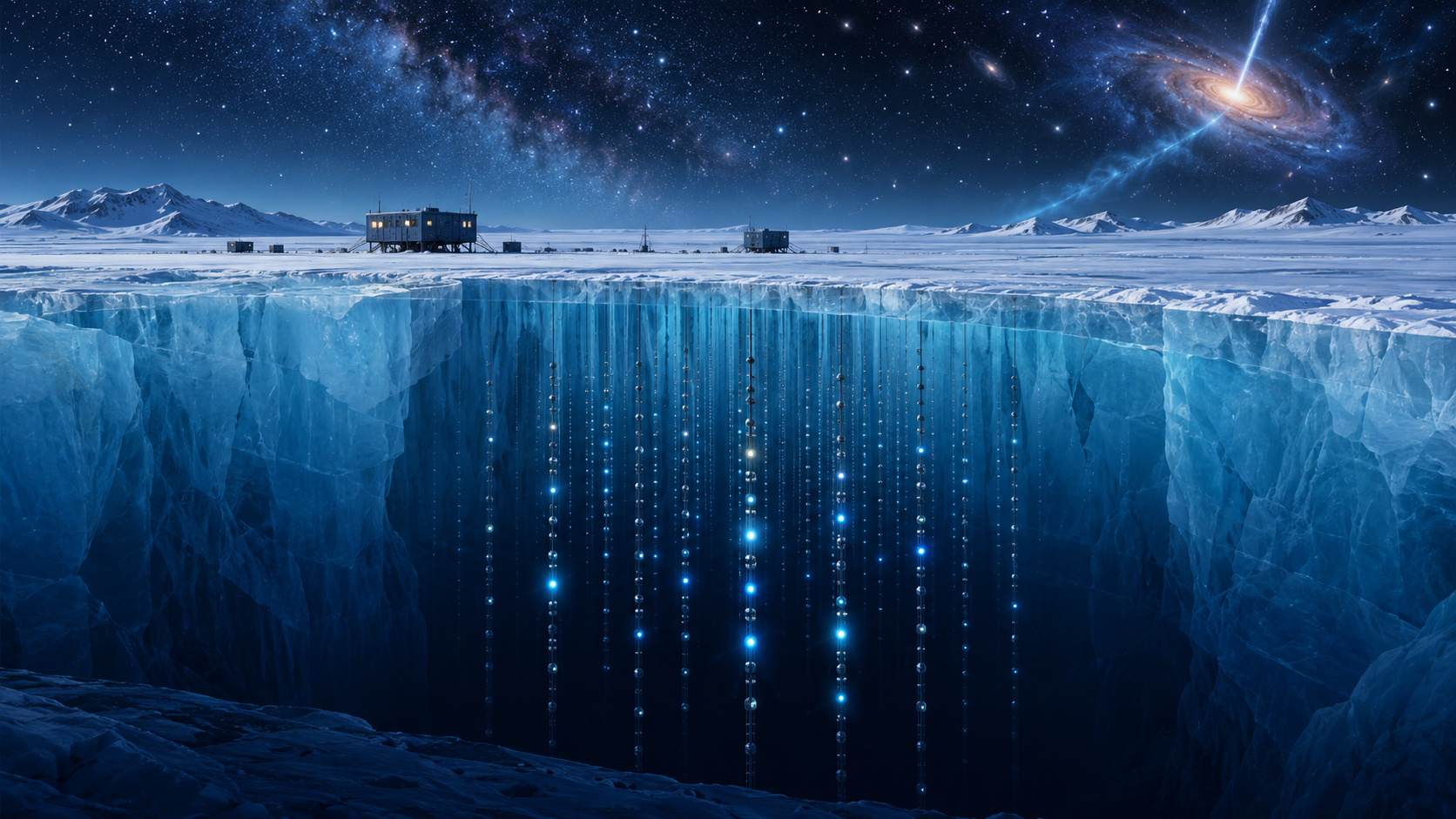
AI-generated conceptual illustration; not a photograph of the event or an exact scientific diagram.
Francis Halzen has won the 2026 Nobel Prize in Physics for his contributions to the IceCube Neutrino Observatory and the discovery of high-energy neutrinos arriving from beyond our solar system. The award was announced on October 6.
The story behind the prize begins with an unusual idea: use the ice beneath the South Pole as an enormous instrument for observing the universe.
Who is Francis Halzen?
Halzen is a physics professor at the University of Wisconsin–Madison and IceCube’s principal investigator. His work brought together scientists and engineers to turn a proposal for detecting elusive particles into an operating observatory.
What are neutrinos, and why call them ghost particles?
Neutrinos rarely interact with ordinary matter. Vast numbers pass through Earth without leaving a detectable trace. The nickname describes that difficulty, rather than anything supernatural.
High-energy neutrinos can carry information from powerful processes far away. Unlike charged cosmic rays, their paths are not bent by magnetic fields in the same way, making them useful clues to their origins.
How does IceCube detect them?
Thousands of light sensors are embedded in a cubic kilometre of Antarctic ice. When a neutrino interacts with matter, the resulting particles can produce light that the instruments register. Researchers analyse these signals to reconstruct the event.
The large volume matters: rare interactions need a large target. IceCube is therefore a telescope without the familiar arrangement of a mirror and lens pointed at the sky.
Which discoveries made the difference?
IceCube began operating in 2011. In 2013, its results revealed high-energy neutrinos from outside the solar system. Later milestones included evidence linking a neutrino to a distant active galaxy in 2018 and a neutrino-based view of the Milky Way in 2023.
Why does this matter?
The discovery gives astronomers another way to investigate the universe alongside light and other signals. It does not answer every question about cosmic accelerators; it gives researchers a new messenger with which to test their explanations.