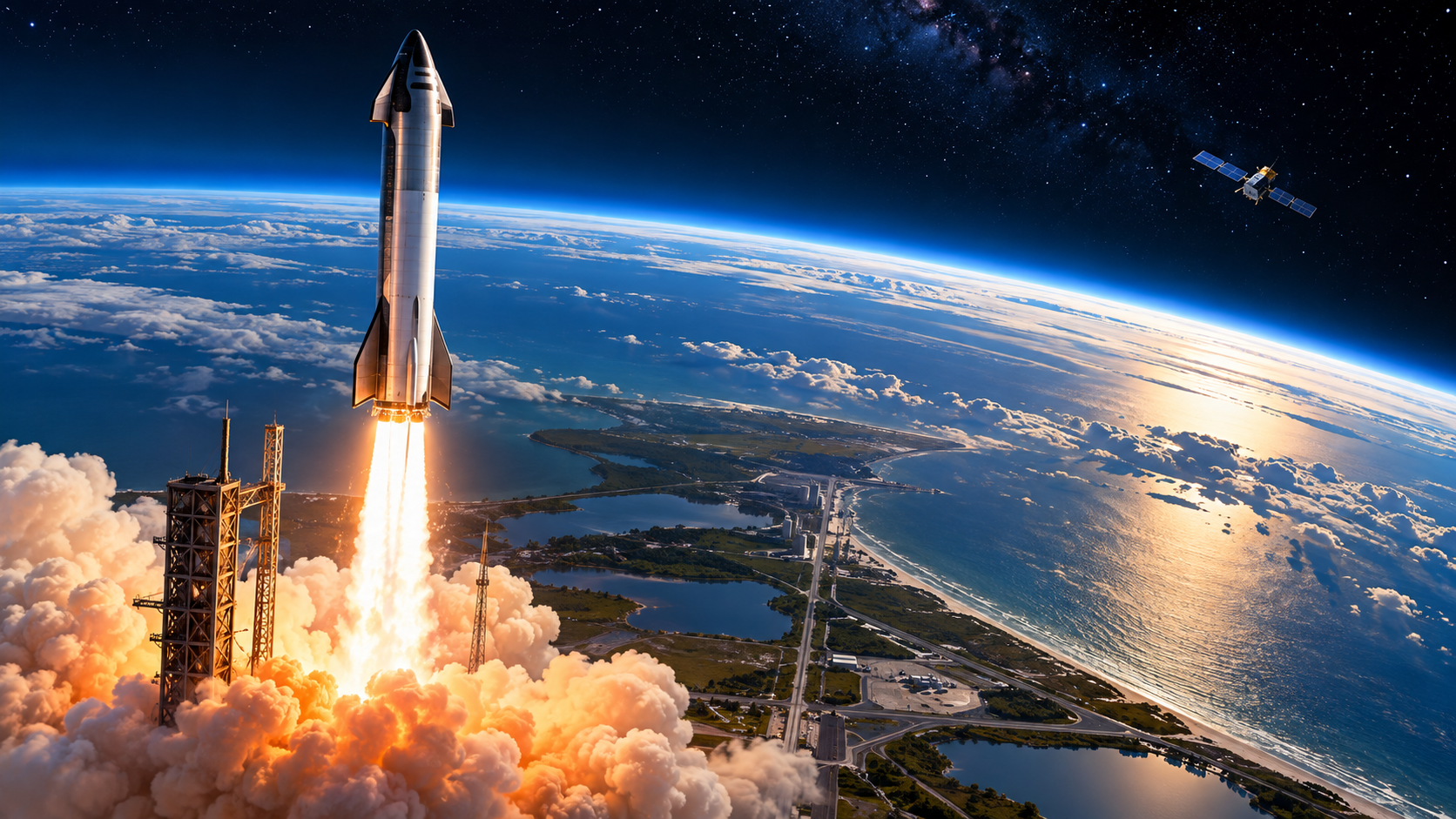
World Space Week 2026 is putting the rocket back at the centre of the space story. Running from 4 to 10 October, this year’s international celebration uses the theme “Rocket Revolution” to examine how access to space is changing—and who can take part.
The United Nations describes a shift from a field once dominated by a small number of government programmes toward one that includes commercial launch providers, reusable rockets, startups, university teams and emerging national space actors. The central question is straightforward: if reaching space becomes more practical, what can people do with that access?
When is World Space Week 2026?
The official dates are 4–10 October 2026. World Space Week takes place during the same week every year; it is an international observance rather than one event at a single venue. Schools, science centres, clubs and organisations can run their own activities.
The two dates carry historical meaning. Sputnik 1, the first human-made satellite, launched on 4 October 1957. The Outer Space Treaty entered into force on 10 October 1967. The UN General Assembly proclaimed World Space Week in 1999.
What does “Rocket Revolution” mean?
The theme focuses on changes in launch technology and participation. A satellite, experiment or spacecraft needs a route away from Earth before it can begin its work. Launch capability is therefore a gateway: it affects which projects are feasible and which organisations can attempt them.
In our explanatory reading of the theme, the revolution is broader than a spectacular liftoff. It concerns the practical chain connecting an idea, a working payload and an opportunity to launch. More participants can bring new experiments and new approaches, but each mission still needs engineering, testing and a clear purpose.
Why reusable rockets attract attention
Reusability means recovering a rocket or a component so that it can be used again, rather than treating every part as disposable. The aim is to make repeated operations more practical. A reusable design still requires inspection and preparation between flights; recovery is one stage of a much longer process.
It is also important to distinguish reaching space from reaching orbit. An object can rise above the atmosphere without remaining in orbit. An orbital mission must achieve the motion needed to keep travelling around Earth. That distinction helps explain why different rockets serve different tasks.
There is no single price or performance figure that describes all launch systems. Payload mass, destination, design and mission requirements differ. This article therefore does not treat reuse as proof that every future launch will be cheaper or simpler.
Why the theme matters beyond astronauts
Space activities connect to familiar needs such as observing Earth, communicating and conducting research. The useful question for readers is not only how a rocket looks, but what its payload will do once it arrives.
For students, the subject also connects physics, coding, materials and teamwork. A classroom model can show one principle; a real mission brings many disciplines together. World Space Week offers a reason to explore those connections without assuming that everyone must become an astronaut.
How can you take part before 10 October?
- Check the official World Space Week website for registered events and local organisers.
- Look for talks or activities at science centres, universities and astronomy clubs.
- Ask a school or community group to build an activity around launch, satellites or Earth observation.
- Verify the date, time zone, location and booking requirements with the organiser.
Activities can have their own schedules; the official week does not mean every local event has the same opening hours. The association’s teacher activity guide is also a useful starting point for educational ideas.
What should readers take away?
“Rocket Revolution” invites a closer look at the route into space. Our view is that its value lies in connecting the excitement of launch with practical questions: who can participate, what will be carried, and what benefit will the mission deliver?
For another science story, read our explanation of the 2026 Nobel Physics Prize and cosmic neutrinos.
Cover image: AI-generated concept illustration, not a photograph of a specific launch or mission.